

The Day the Wind Had Something to Say
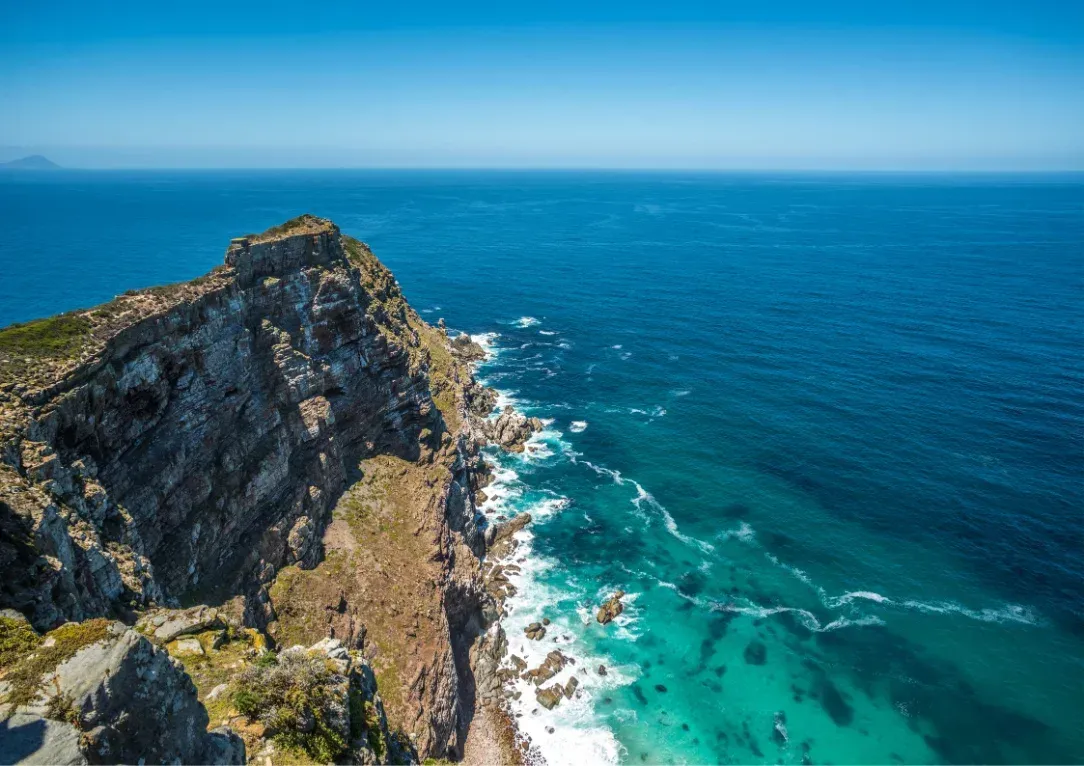
Cape Point — the Atlantic announces itself.
Everyone warned me about the wind at Cape Point. "It's strong," they said, in the way people say things are hot before you travel to a desert, meaning well but failing entirely to convey the true scale of the thing. The wind at Cape Point is not strong. The wind at Cape Point is a presence. It has intent. It leans against you with what feels like personal interest and it shouts continuously in both ears and your eyes water and you stand at the railing above the sheer cliffs and think: this is what the planet actually is, under all the layers we've put on top of it.
I loved it immediately.
Getting There — The False Bay Coast
We drove south from Cape Town along the False Bay coast, and I want to spend a moment on this drive because it's one of those journeys that deserves its own paragraph. Muizenberg first, with its famous beach huts in stripes of red and yellow and white, set against a beach that seems to go on for ever. Surfers in the morning break. The smell of the ocean coming through the slightly open window — clean and cold and somehow particular to this specific ocean, the Indian side of the Cape, warmer than the Atlantic.
Through Kalk Bay, where the working harbour is tiny and loud and smells of diesel and fresh fish and the restaurants are already putting their chalkboards out. I asked our guide to slow down outside a shop with small blue fishing boats pulled up alongside it and piles of snoek — South Africa's great fish, silver-grey and long, laid out on the dock. A man was filleting one with the speed and precision of someone who has done this ten thousand times and will do it ten thousand more.
Simon's Town — The Town That Time Forgot
Simon's Town is a naval town — South Africa's principal naval base since the 1800s — and it carries its history lightly, in the way of old places that have simply seen too much to make a fuss about it. The Victorian facades along the main road are painted cream and ochre and terracotta. There's a museum in the old station building. There's a bronze statue of a Great Dane named Just Nuisance — a dog who was the only animal ever officially enlisted in the Royal Navy — outside the station, looking out to sea with the same stoic naval bearing as his former colleagues.
I bought a cup of tea from a small café and drank it on a bench outside, watching the fishing boats coming into the harbour in the low morning light. The tea was strong enough to stand a spoon in and came with two shortbread biscuits that crumbled in the particular way of very good shortbread. This moment — the tea, the biscuits, the harbour, the mountains above — will stay with me longer than many more things I have seen.
Chapman's Peak Drive — one hundred and fourteen curves above the ocean.
Inside the Reserve — Fynbos and Baboons
The Table Mountain National Park begins well before Cape Point itself, and driving through it is its own experience. The vegetation here is fynbos — that extraordinary, highly diverse Cape floral kingdom that exists nowhere else on earth — low and wind-sculpted and in constant bloom if you look closely enough. In September the proteas are out, those extraordinary architectural flowers, deep pink and cream, rising above the grey-green scrub like something ceremonial.
The baboons appeared without warning, as they always do, sitting calmly in the middle of the road with the entitled air of residents dealing with tourists. Our guide slowed to a stop. A large male sat directly in front of us, assessed the vehicle, found us acceptable, and continued his investigation of something on the tarmac. A female was nursing an infant on the verge. Two youngsters were playing in the scrub with a focused intensity that looked exactly like play the world over. "Windows up," our guide said, with the tone of someone who has learned this lesson personally. I closed mine immediately.
Cape Point — Finally
And then, Cape Point. There's a build to it — the road winds through the reserve and you see glimpses of the sea below to either side and the land narrows and narrows until you are on a thin green spine above the ocean and then the car park and then you walk, or take the funicular, and then you are there.
The old lighthouse stands on the highest point. It was decommissioned in 1919 because it sat above the fog line — in bad weather it was invisible from ships below — and replaced with the current lighthouse lower on the cliff. The old one remains, weathered and white and stoic, and I walked up to it in the full noise of the wind and stood with my hands on the railing and looked south.
Nothing. Ocean. All the way to Antarctica, nothing but ocean. The waves breaking at the base of the cliff two hundred metres below were reduced to silence by the wind and the distance, and yet you could feel them in the rock through your feet. The continent ended here. Africa ended here. I had stood on my share of dramatic cliffs and lookout points but this was different. This was an edge.
The continent ended here. Africa ended here. I had stood on my share of dramatic cliffs but this was different. This was an edge.
The Drive Home — Chapman's Peak Again
Coming home the Atlantic way, over Chapman's Peak, the light was late afternoon and the ocean below was no longer the hard blue of morning but something warmer, shifting between teal and copper where the sun hit it. I didn't talk much. The guide played a playlist of South African jazz — something with a slow, considered trumpet — and we drove along the face of the mountain above the sea and I thought about the wind at Cape Point, the strength of it, the honesty of it.
Book your Cape Point & Peninsula Tour at www.intotours.co.za or WhatsApp +27 60 986 7612.